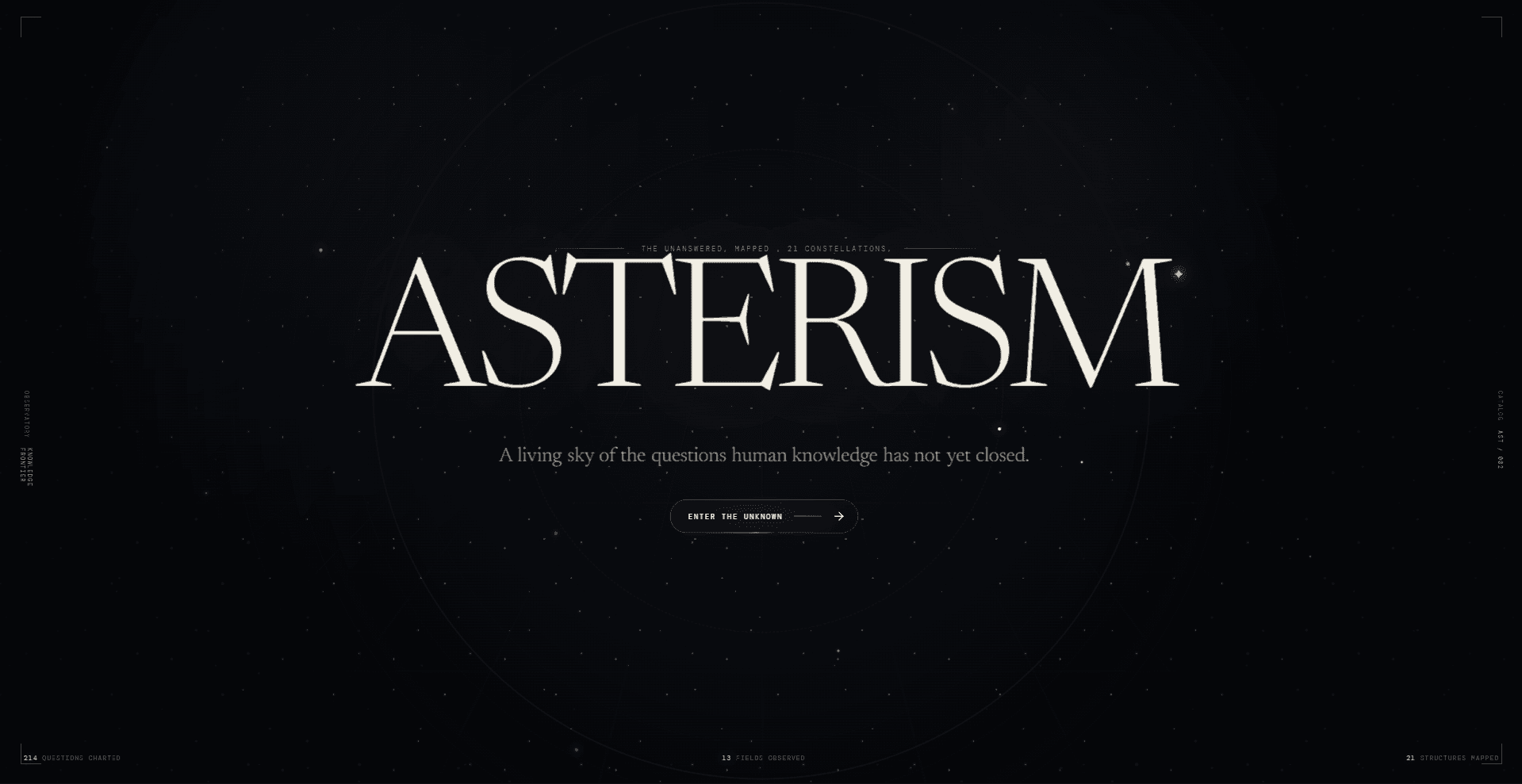
Asterism turns unresolved problems into an explorable sky. Its 214 signals span 13 fields, from mathematics and physics to medicine, language, and society. Related questions gather into 21 named constellations so the shape of an unknown becomes visible alongside the question itself.
Why I built it
Open problems are usually presented as lists: important individually, but detached from the neighboring ideas, methods, and systems that make them meaningful. Asterism treats those relationships as part of the interface.
Each star represents an unresolved question. Local links reveal a shared research neighborhood, while rarer cross-field bridges appear only when a selection or curated trail makes them useful. The result is meant for wandering without turning the knowledge frontier into an unreadable wall of nodes.
Two ways to explore
The atlas has two complementary projections. Sky is a spatial graph with authored negative space between constellation islands, designed for discovery through panning, pointer-centered zoom, search, and focus. Atlas rearranges the same catalog into an ordered grid for taxonomy and comparison.
Semantic zoom makes scale an information hierarchy. The overview emphasizes constellation names and local topology; deeper levels progressively resolve individual questions while keeping stars, labels, and connecting lines legible on screen.
Research dossiers and trails
Opening a signal reveals a dossier with the question, its research context, why it remains open, what a resolution could change, related signals, and a reference where one is supplied. Curated trails connect questions across fields around themes such as reality, life, prediction, climate, civilization, and trustworthy machines.
This makes Asterism more than a visualization of a fixed catalog. Search, trails, field filters, constellation focus, and a random drift action provide different ways into the same underlying map.
Interaction and engineering
I built Asterism with React, TypeScript, Vite, DOM interaction targets, and a custom Canvas renderer. The graph uses one compositor transform for pan and zoom, screen-space tooltips for readable hover identity, and counter-scaled labels so deep zoom creates separation without turning the interface into oversized UI.
The responsive observatory becomes a draggable bottom sheet on phones. Keyboard shortcuts, visible focus behavior, reduced-motion handling, lower-power fallbacks, and touch gestures are part of the interaction model rather than separate modes.
What shipped
- 214 unresolved questions across 13 fields and 21 named constellations
- Spatial Sky and ordered Atlas projections over the same catalog
- Five semantic zoom depths with progressive label disclosure
- Search, field filters, curated trails, constellation focus, and random drift
- Research dossiers with context, related signals, and references where supplied
- Responsive mouse, keyboard, trackpad, and touch navigation
Explore the project
Explore Asterism at asterism.brandondeonarine.com.